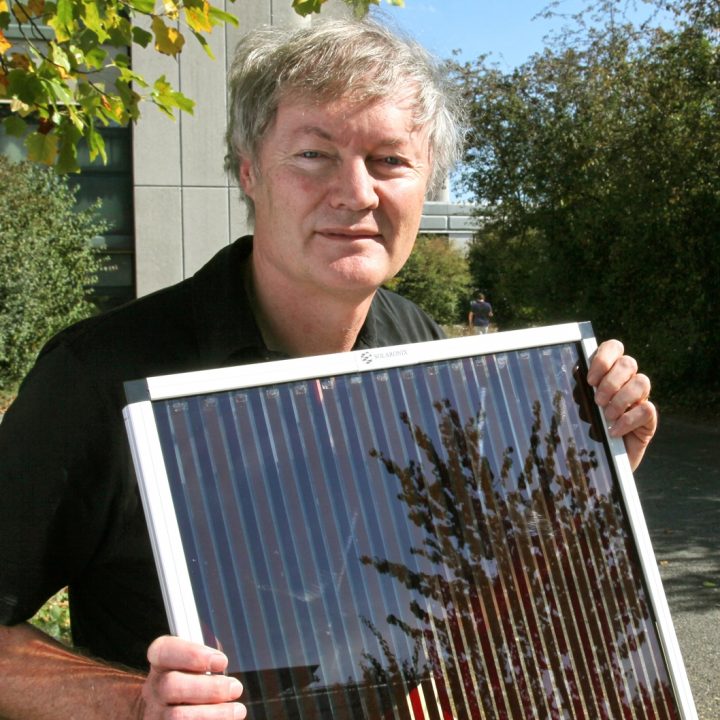


PROFESSOR SIR RICHARD FRIEND: DEVELOPER OF PLASTIC ELECTRONICS
The 2010 Millennium Technology Prize Laureate Sir Richard Friend's initial innovation, organic Light Emitting Diodes (LEDs), was a crucial milestone in plastic electronics. He showed a method to use polymers as solution processed semiconductors. Electronic paper, cheap organic solar cells and illuminating wall paper are examples of the revolutionary future products his work has made possible.
Cavendish Professor of Physics, the University of Cambridge, United Kingdom
Born January 1953 in London, United Kingdom.
Timeline
1988 Polymer field-effect transistor demonstrated
1990 Polymer LEDs demonstrated
1995 Efficient polymer photovoltaic diodes demonstrated
2000 World's first full colour ink-jet printed PLED display
2009 Google, Nokia, Samsung selling millions of phones with touch OLED screen, first OLED lighting panel
"For his contributions in the area of plastic electronics. His work is leading to a variety of products with high energy efficiency and reduced environmental impact. Polymer-based materials are bringing about a revolution and paradigm shift in the optoelectronics sector, with far-reaching consequences for applications in display devices, lighting, sensing and solar energy harvesting." - International Selection Committee
In electronic devices different materials have different functions. Traditional electronics rely on inorganic conductors such as copper and doped silicon. Copper wires conduct electricity; silicon semiconductor chips do the computing. Polymer plastics are generally insulators, blocking the passage of electrical current. They are an excellent choice for around wires to prevent short circuits, or to shape mobile phone covers. Or so traditional thinking would suggest.
Today many new phones have touch OLED screens. OLED stands for Organic Light Emitting Diode, made of conductive plastic material. The material is called “organic” because the polymers used are carbon-based, much like living organisms. Soon we may see 100 inch high-definition TV-sets, which are only few millimetres thick and can be rolled up when not in use, or paper-thin, inexpensive lighting panels covering the whole wall. Electronic components based on polymers have made these applications possible.
Friend’s inventions were landmark achievements in the rise of plastic electronics. In the late Eighties, his research group discovered that conjugated polymers behave in many respects like inorganic semiconductors and can be used in a number of semiconducting devices. Realising the significance of their discovery Richard Friend, Donal Bradley and Jeremy Burroughes filed a patent for polymer LED in April 1990.
|
Wikipedia article about plastic electronics Wikipedia article about organic LEDs |
Thanks to their pioneering discoveries, plastic electronics has now developed into a large international research field with significant academic and industrial activities. Polymer LEDs are already used in small displays, and energy-efficient lighting applications are being developed. Polymer photovoltaic diodes promise to enable very low cost solar cells. Printed polymer transistors enable new electronic applications such as flexible and transparent displays.
An important characteristic of plastic electronics is the simplicity of the method used to produce them. Inorganic transistors require massive vacuum systems and complex manufacturing processes. However, the organic polymer materials Friend used can be dissolved in organic solvents to create "inks" that can be used to create circuits simply by printing them under normal atmospheric conditions.
It is easy to understand the global electronics industry's huge interest in organic and solution processable semiconductor technology. The ability to apply low temperature, low cost transistors and LEDs to flexible materials using a process that could be as simple as painting can enable new products that, until now, were unfeasible.